

By Gina Shaw
In the wake of the FDA’s Feb. 21, 2025 announcement declaring an end to the semaglutide (Ozempic/Wegovy, Novo Nordisk) shortage, stakeholders in the compounding arena offered their take on the agency’s decision and how it may affect patients’ ability to access—and afford—the blockbuster weight-loss medication.
The most immediate result of the action will be to dramatically limit the ability of compounding pharmacies to make their own versions of semaglutide. The FDA announcement gave 503A compounders 60 calendar days to stop production of “essentially a copy” of the GLP-1 medications until April 22 this year; 503B compounders were given 90 days, until May 22.
The FDA declared the semaglutide shortage over based in part on Novo Nordisk's assurances that the company's "stated product availability and manufacturing capacity can meet the present and projected national demand," an agency statement noted. "Patients and prescribers may still see intermittent and limited localized supply disruptions as the products move through the supply chain from the manufacturer and distributors to local pharmacies."
Compounding pharmacists have known that the shortage would not last forever, acknowledged Scott Brunner, the CEO of the Alliance for Pharmacy Compounding. “For three years—that’s how long this wonder drug has been in shortage—[compounders have been making] copies of semaglutide injection for patients at a time when Novo Nordisk could not meet the extraordinary demand,” he said in a statement. “They’ve been serving patients who’d otherwise have no access to this medication. But they’ve also known that eventually the shortage would be resolved, and they’ve been prepping patients for months to expect that eventuality.”
Mr. Brunner added that “we can argue about whether this resolution of the shortage is premature or not—indeed, the much more real-world ASHP shortage list continues to show both semaglutide and tirzepatide injection in shortage. And I do question whether in resolving the shortage FDA has taken into account demand for the compounded drug—the number of patients who’ll need to be transitioned from compounded version to FDA-approved version. That’s likely hundreds of thousands of patients.”
Off-Ramp Period Is Critical
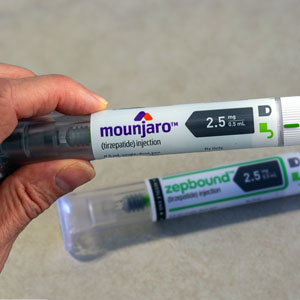
Mr. Brunner praised the FDA for building in an off-ramp period to allow prescribers to transition patients to FDA-approved forms of the drugs if available, something the agency did not originally do when declaring an end to the shortage of tirzepatide (Zepbound, Novo Nordisk) in the fall of 2024. The Outsourcing Facilities Association (OFA) responded to that decision with a lawsuit challenging the determination, and seeking a temporary restraining order (TRO) that would enjoin the agency from taking action against tirzepatide compounders while the suit is pending. The FDA responded by stating that it would review its decision, and in December 2024, it issued a new order ending the shortage but giving off-ramp periods similar to those in the new semaglutide order.
“That period … can help avoid an interruption of therapy for many patients. We’re grateful to the agency for hearing us and granting that off-ramp,” Mr. Brunner said. “All we can do now is watch what happens as patients hear this news and their providers and pharmacists work to get them a new prescription for the FDA-approved drug. There’s likely to be some sticker shock for many, and whether they’ll be able to continue to afford the therapy remains to be seen.”
Some Semaglutide Compounding Will Continue
The FDA’s determination doesn’t necessarily mean that all semaglutide compounding will come to an end, however. “All compounding of ‘essentially a copy’ will end with those grace periods,” clarified Martha Rumore, PharmD, JD, a pharmacist-attorney in the Life Sciences Department of the law firm Frier Levitt. “The FDA has an entire guidance on what is and what is not ‘essentially a copy.’ Some of those parameters include plus or minus 10% of the dosage and strength, or addition of another drug—perhaps something like vitamin B12, because the patient is experiencing fatigue.”
Dr. Rumore stressed, however, that “just adding another drug does not necessarily make a compound not ‘essentially a copy,’ if what they are adding is also at commercially available strength. Compounders really need legal guidance on this.”
She added that the new determination does not affect the hold placed on enforcement of the tirzepatide determination while the OFA lawsuit is pending. The Feb. 21 announcement also included clarification that the FDA will not take action against 503A compounders until Feb. 18, 2025 (a date that has passed) and 503B compounders until March 18, 2025—or until the date of the district court’s decision on the plaintiffs’ preliminary injunction motion in Outsourcing Facilities Association (OFA) v. FDA, whichever is longer.
“If OFA is successful on the preliminary injunction motion, that means that FDA is basically enjoined from enforcing the prohibition on compounding essentially a copy of tirzepatide until the case is decided, whenever that is,” Dr. Rumore said. “On the other hand, if the OFA is unsuccessful, then there may be an immediate cessation of compounding because the grace period is over or nearly over.”
In any case, Dr. Rumore cautioned, prescribers should be considering how to transition their patients to commercially available versions of these products wherever possible. “The key is to avoid disruption of patient care,” she said.
The sources reported no relevant financial disclosures beyond their stated employment.