

Originally published by our sister publication Specialty Pharmacy Continuum

A tailored clinical monitoring schedule that focused on oral oncolytics with high rates of adverse events (AEs) slashed treatment interruptions by more than 50% and significantly reduced medication-related hospitalizations, according to a new study by specialty pharmacists from Vanderbilt University Medical Center, in Nashville, Tenn.
“We are focused on looking at oral oncolytics individually by medication,” explained Autumn Zuckerman, PharmD, Vanderbilt’s director of specialty pharmacy. “Based on this specific drug’s side effect profile and monitoring scheme, how do we best follow up with the patient to optimize adherence?”
One class of oral oncolytics with particularly high rates of AEs is the poly(ADP-ribose) polymerase (PARP) inhibitors, including niraparib (Zejula, GSK), olaparib (Lynparza, AstraZeneca), rucaparib (Rubraca, Pharmaand GmbH) and talazoparib (Talzenna, Pfizer). In a single-center, pre- and post-intervention study presented at the HOPA Annual Conference 2024, in Tampa, Fla. (abstract CR16), the Vanderbilt specialty pharmacy oncology team created a call schedule in which specialty pharmacists contacted PARP inhibitor patients at the time these anticipated side effects would occur.
“We know that around day 13 and day 21 is when nausea and other gastrointestinal side effects have the most impact. With the much higher rate of AEs earlier in treatment, we can address those issues with the patient,” Dr. Zuckerman said.

In the pre-intervention comparator arm of the study, which extended from November 2017 to October 2019, patients would receive refill calls from pharmacy technicians on days 30, 60 and 90. During those calls, Dr. Zuckerman noted, they would often report AEs. In the intervention arm, from July 2021 through October 2022, patients on PARP inhibitors also received calls from a specialty pharmacist in between the refill calls—on days 5, 14, 21, 35 and 42, according to the results, which primary investigators Brooke Looney, PharmD, CSP, and Stephanie White, PharmD, CSP, presented at the HOPA meeting.
“The pharmacists ask questions such as how the medicine is being taken, how many doses they’ve missed and what side effects they’re experiencing,” Dr. Zuckerman said. “If side effects are reported, they go through mitigating strategies with them, and alert the prescribing physician if needed.”
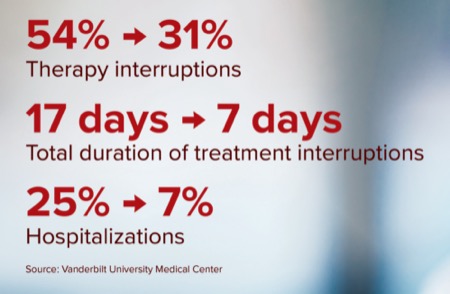
The study found that not only did therapy interruptions decrease, from 54% of patients in the pre-intervention arm to 31% post-intervention, but the total duration of treatment interruption also declined from an average of 17 to seven days. “We also found that hospitalizations declined significantly as well, from 25% of patients in the pre-intervention group to only 7% afterward, which we are very excited about,” Dr. Zuckerman said. However, she cautioned that it was a small study, with only 28 patients in the pre-intervention cohort and 29 in the intervention, because of its specific focus on one medication class.
“Nonetheless, I think this really shows that a tailored approach can help in the drug classes where patients really struggle early on with side effects,” Dr. Zuckerman said.
Building on Earlier Results
This study builds on findings from a poster presented at AMCP Nexus 2019, in which Vanderbilt’s specialty pharmacists assessed a similar tailored monitoring approach for the management of side effects and adherence to two oral multikinase inhibitors, regorafenib (Stivarga, Bayer) and sorafenib (Nexavar, Bayer).
“These medications also have side effects early on in therapy that can impact patients’ ability to stay on treatment,” Dr. Zuckerman said. By supplementing a standard series of refill calls with scheduled intervention calls specific to each drug’s AE profile, she noted, her team reported a 28% reduction in discontinuation of therapy and 55% reduction in patients requiring dose reduction.
An additional study with negative results speaks to the benefits of drug-specific tailored monitoring. “We repeated this approach at the request of the manufacturer for two medications, encorafenib [Braftovi, Pfizer] and binimetinib [Mektovi, Pfizer], and found no difference in discontinuations or dose changes,” Dr. Zuckerman said. “This was not too surprising to our pharmacists, because we didn’t think patients struggle as much with AEs in those classes. Despite not impacting our primary outcomes, we did see the benefit of early monitoring by being able to identify and help mitigate AEs early in therapy. This tells us that a tailored monitoring approach is particularly important in specific classes where patients are more affected by AEs and others may benefit from one additional touchpoint prior to their first refill.”
A History of Help
Health-system specialty pharmacy interventions have been found to be generally beneficial for patients on oral oncolytics. In a 2021 study published in the Journal of Managed Care Specialty Pharmacy, investigators at Beth Israel Deaconess Medical Center, a part of the Beth Israel Lahey Health system, a multisite system based in Boston, found that patients on oral oncolytics served by the system’s internal specialty pharmacy saw significantly improved adherence, as measured by proportion of days covered (0.99 vs. 0.91; P<0.01), medication possession ratio (1.00 vs. 0.93; P<0.01) and time to treatment (five vs. 27 days) (J Manag Care Spec Pharm 2021;27[10]:1438-1446).
“Most of the new drugs coming out in the oncology space are oral, because everyone is realizing that these tablets are so much easier for the patient to continue on,” said Luca Cattaneo, RPh, the director of specialty pharmacy for Beth Israel Lahey Health. “This is where the industry is going. But although they are easier, there are still significant adherence challenges. Barriers include access issues such as insurance restrictions and out-of-pocket costs, sometimes complicated medication dosing schedules, and, of course, AEs.”
To help patients manage AEs, Beth Israel Lahey Health has a dedicated group of ambulatory care specialty pharmacists working in the oncology clinic alongside prescribers. “They are the medication experts when it comes to oral oncolytics,” Dr. Cattaneo said.
“We now have a group of five full-time pharmacists in that space, working full-time with oncology physicians and patients and assigned to specific categories of malignancies.”
At Vanderbilt, Dr. Zuckerman and her group are conducting a prospective randomized study assessing the efficacy of portal messaging between seven and 14 days after oral oncolytic initiation, confirming that the patient has started their medication, asking about side effects, and whether or not they have any questions for the pharmacist. “Those results will be presented at the ASHP Midyear Clinical Meeting in December,” she said. “I think we have had a very nice progression around tailored monitoring, showing how we can implement it in a way that’s not invasive or burdensome but can be impactful, particularly for patients on schedules with a high AE profile.”
The sources reported no relevant financial disclosures.