





Originally published by our sister publication Anesthesiology News
UF Department of Anesthesiology
University of Florida
Gainesville
Over the years, significant strides have been made in improving productivity, efficiency and safety by considering human factors in the workplace. By focusing on the interaction between humans, teams, technology, processes and workplace design, we aim to reduce errors and make healthcare delivery more cost-effective.
Medication safety is paramount in anesthesia.1-3 Medication errors are the most common cause of medical errors, with medication therapy being the most common type of treatment. Medication errors typically refer to situations of the wrong drug, wrong patient, wrong route or medication overdose.4 The incidence of anesthesia and critical care–related medication errors is common, with reports indicating such errors occur in 1 out of 133 to 450 medication administrations.1,4 The incidence of life-threatening complications is estimated at 1% to 2%,5 at an annual cost of $5.3 billion.6
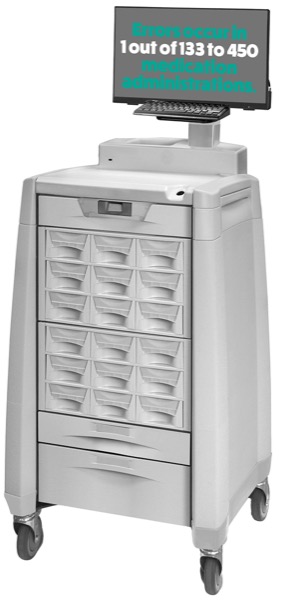
Technology has the potential to enhance medication safety, minimize medication errors and decrease patient harm. One proposed solution for reducing risk factors associated with medication errors in the operating room is using automated medication storage and dispensing systems (ADS). These systems require a password or bio-identification to release individual medications, which can further improve the safety of medication administration.7
We present a case of a near-miss event in the OR that uncovered flaws in the implementation of an ADS that could have resulted in serious patient harm. We must not overlook how these newer methods of dispensing, distributing and administering medications in the OR can bring new challenges and problems and how vital provider education, critical incident reports and a culture of safety concerning medication safety continue to be in our daily anesthesia practices.
A 66-year-old woman, with a body mass index of 26.2 kg/m2 and a 50-year smoking history, was scheduled for panendoscopy, tonsillectomy and biopsy of the base of the tongue for suspicion of oropharyngeal cancer. Preoperative evaluation and endoscopy did not reveal obstructive masses or vocal cord involvement. The patient was brought to the OR, where an IV induction was performed with propofol and rocuronium.
Video laryngoscopy revealed a grade I glottic opening, and the patient was intubated on the first attempt without difficulty. The procedure lasted 60 minutes. At the end of the case, the patient received sugammadex 200 mg for muscle relaxant reversal and was extubated when spontaneous ventilation occurred. Although the goal was to have a smooth emergence, the patient bucked and coughed vigorously while still intubated and became agitated when the tube was removed.
Profound oropharyngeal bleeding ensued, and the patient developed respiratory distress. The decision was made to reintubate and explore the source of the bleeding. Because of the profound bleeding and the recent reversal with sugammadex, the plan was to perform a rapid sequence induction (RSI) with etomidate and succinylcholine.
Unfortunately, when the ADS was accessed, neither medication was available in the system in the room because the unit had not been stocked with these medications. Additional help was summoned, and while we were waiting for the RSI medications from another location, a supraglottic airway (SGA) was placed because oxygen saturation levels were dropping below 90%.
The patient was ventilated, but there was a copious amount of blood in the SGA. A successful RSI was performed afterward. Reexploration and additional cauterization of the source of the bleeding were performed. For the second extubation attempt, the patient received dexmedetomidine (30 mg IV) to decrease the agitation and she was extubated a second time without further problems.
The OR is a fluid, dynamic environment where emergencies happen unexpectedly, and time pressure is the norm. The Anesthesia Patient Safety Foundation (APSF), in 2010, proposed a new paradigm to reduce errors related to medications. It used the acronym STPC, which stands for Standardization, Technology, Pharmacy/Prefilled/Premixed and Culture.
This model emphasized standardization, concentration and dilution of high-alert anesthesia drugs for bolus or infusion, a mechanism to identify such medications (barcode reader), the use of pharmacy-prefilled premixed medications, and a culture of safety to report errors and near misses concerning medication administration in anesthesia.8
ADS improve medication safety and accessibility, and also facilitate charging, billing and medication reconciliation, including controlled substances. There is evidence of the benefits of clinical and economic outcomes in hospital wards.9 Our hospital decided that our central pharmacy would implement and be responsible for running the OR’s ADS.
However, early in the implementation, we uncovered newer potential problems and challenges we had not experienced before. For the ADS to work in the OR, discussions about ergonomics, drawer design and fit must be established. More importantly, policies and procedures must be established for inventory levels, refill schedules and adequate supplies of essential anesthetic medications.
Safe medication administration is a complex process that requires attention to detail and careful consideration of each step involved. In this case, a new automated medication dispensing system is needed to ensure the correct medication can be administered to the right patient at the right time.
Urdaneta serves as a consultant to Medtronic, but there are no conflicts of interest in the subject.
References
- Kothari D, Gupta S, Sharma C, et al. Medication error in anaesthesia and critical care: a cause for concern. Ind J Anaesth. 2010;54(3):187.
- Hanna GM, Levine WC. Medication safety in the perioperative setting. Anesth Clin. 2011;29(1):135-144.
- Toff NJ. Human factors in anaesthesia: lessons from aviation. Br J Anesth. 2010;105(1):21-25.
- Glavin RJ. Drug errors: consequences, mechanisms, and avoidance. Br J Anesth. 2010;105(1):76-82.
- Nanji KC, Patel A, Shaikh S, et al. Evaluation of perioperative medication errors and adverse drug events. Anesthesiology. 2016;124(1):25-34.
- Langlieb ME, Sharma P, Hocevar M, et al. The additional cost of perioperative medication errors. J Patient Saf. 2023;19(6):375-378.
- Fox EC, Misko J, Rawlins MD, et al. A survey of operating theatre staff on the impact of automated medication dispensing systems in operating theatres in an Australian hospital. Anaesth Intensive Care. 2023;51(3):207-213.
- Eichhorn JH. APSF hosts medication safety conference. APSF Newsletter. 2010;25(1):1-8.
- Liou JH, Wang SC, Hou YC, et al. Effect of an automated dispensing cabinet system on drug distribution effectiveness in a surgical unit. Heliyon. 2023;9(11):e21668.