





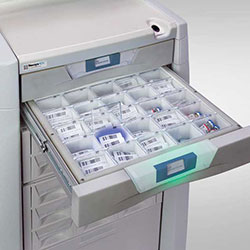
Automated dispensing cabinet (ADC) vendors should incorporate dynamic search capabilities to prevent medication errors with drug names that look alike or sound alike, urged experts from the Institute for Safe Medication Practices (ISMP) in a May 31 Call to Action. The letter also included several other safe practice recommendations for drug selection (see box).
Since 2019, ISMP has recommended entering at least the first five characters of a drug name, unless the name has fewer than five letters, during ADC searches when the item has not yet been added to the patient’s medication profile. But that approach has its own limitations and challenges; a recent study found that the number of overlapping characters in medication names varies widely—anywhere from four to 29 characters overall, and three to 10 among high-alert medications (Am J Health Syst Pharm 2024;81[14]:622-633).
“Some medication names overlap by only a few initial characters (e.g., INDERAL and INDOCIN); others overlap by seven or more initial characters (e.g., hydroxychloroquine and hydrOXYzine),” the authors wrote. “Less frequently, medication names overlap by ten or more initial characters (e.g., PHENobarbital and PHENobarbital with belladonna alkaloids).” The researchers concluded that drug search safety could be significantly improved by upgrading systems to respond dynamically to each keystroke entered.
“If ADC systems could be smarter and force the user to type enough characters so that there wasn’t an overlapping name, that would solve much of the problem,” Christina Michalek, BS, RPh, FASHP, ISMP’s director of Membership and Patient Safety Organization, told Pharmacy Technology Report. “The major ADC vendors do seem to be very committed to safety, and they appreciate the information, recommendations and error reports that we share with them, so I have confidence they will be considering it.”

ISMP also recommended that vendors promote the use of standard medication names and presentations in all medication-use systems (e.g., “Tylenol with Codeine #3” as opposed to “Tylenol #3”), and remove length limits on medication name fields, because these limits sometimes force those who configure medication-use systems to devise cryptic names.
“As there are some legitimate reasons to allow customization into the name of a particular medication within an organization, to the degree that we could customize naming, that would help further support this dynamic search function,” Ms. Michalek said.
W. Perry Flowers, RPh, MS, the vice president of medical affairs, medication management solutions for BD, noted that “BD Pyxis automated medication dispensing technology currently supports the use of both the generic name and brand name within a search attempt. This capability expands the opportunity of matching the correct medication rather than only using the generic name, which, as ISMP points out, could lead to selection errors.” BD has also reviewed the approach for name searches described in the recent study, he said. “In conversations with healthcare leaders, other options such as phonetic lookup and voice-to-text search capabilities are mentioned. Clearly, more scientific research is needed to identify a set of technology tools that increase the likelihood of accurate medication selection while not restricting access to medications needed for patient care.”
The ISMP alert also urged hospital and health-system pharmacies to take action to improve safe drug selection, most notably requiring that indications be selected for certain override medications. “We know from multiple studies that having an indication is one of the most impactful pieces of additional information that can prevent the mis-selection of medications with similar names,” Ms. Michalek said. “For example, hydrOXYzine is used to relieve itching and hydrALAZINE is used to lower blood pressure. As long as I’ve been a pharmacist, people have mixed these drugs up, and we continue to receive errors for those drugs. Requiring users to confirm medication selection on-screen by selecting an indication would go a long way to avoiding some of these errors” (J Am Med Inform Assoc 2018;25[7]:872-884).
Ms. Michalek reported no relevant financial disclosures.

This article is from the September 2024 print issue.