





Focusing clinician attention on “good catch reports”—intercepted medication-related problems or potential safety issues that are identified before reaching the patient—not only led to a nearly 500% increase in such reports but, unexpectedly, to the improvement of overall medication event reporting in an Arkansas health system, according to a poster (35-M) presented at the ASHP Pharmacy Futures 2025 meeting, in Charlotte, N.C.
Attention-grabbing measures included publicizing the reports through sticky notes posted to a highly visible whiteboard, and by integrating them into the electronic health record (EHR), reported Carlette Seng, PharmD, a medication safety officer at the University of Arkansas for Medical Sciences (UAMS), in Little Rock.
When Dr. Seng took on the position of medication safety officer at UAMS in 2021, she observed that medication error reporting was unimpressive. “We had very low numbers and a lot of frivolous things being reported,” she said. “There was not a lot of meat to the data as well. So, I decided to take a positive approach and start focusing attention on ‘good catches.’”
She hit on the idea of encouraging pharmacy staff to use customized, logoed sticky notes to write up short reports of those good catches (with the minimum required information and no identifiable personal health information) and post them on the central whiteboards found in high-traffic, high-visibility secure pharmacy work areas. Pharmacy staff were targeted because they provide services throughout the health system, including inpatient, outpatient, infusion, perioperative spaces and regional programs.
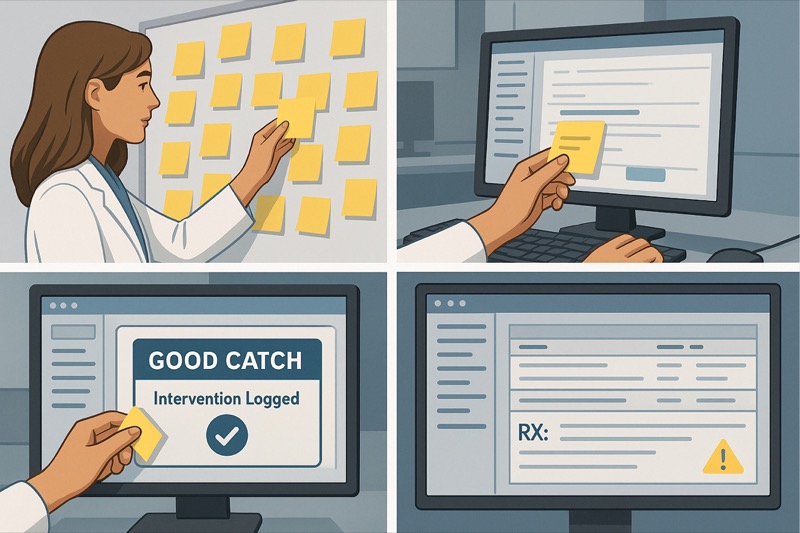
“They had a visual indicator of the good catches reported by their peers in real time. And then every Monday, I would come in and collect them and a member of my staff would enter them into our reporting system,” Dr. Seng explained.
This phase of the intervention went from January to June 2023. Beginning in July of that year, following a suggestion from a front-line pharmacist, a voluntary good catch “outcome” option was added to pharmacist intervention documentation in the inpatient and clinical EHR, allowing pharmacists to select “good catch” without leaving the EHR or filling out a form in another reporting system. A medication safety pharmacist validates an EHR-generated report of all good catch interventions.
As a result, good catch reports rose from an average of 19.7 per month in the first quarter of 2022 (prior to the intervention) to an average of 117.3 per month in the second quarter of 2024—a 496.6% increase over 21 months.
“The power and the strength of a good catch is that someone is telling us about what could possibly be a system failure, and the rule of thumb is for every one reported, there are nine that go unreported,” Dr. Seng said. “So, we took these good catches seriously just like we would have a harmful event, and we tried to act upon them in a just culture, systemwide method.”
Results were tracked by the number of system opportunities identified; between August 2024 and March 2025, 240 unique opportunities were identified, and 120 system changes were implemented, with Institute for Safe Medication Practices (ISMP) high-leverage interventions prioritized. (In a 2023 report, ISMP detailed how it breaks down medication safety interventions into high-, medium- and low-leverage groups; bit.ly/3JcxcDT.) “For example, we had an ongoing problem with Lovenox [enoxaparin, Sanofi-Aventis] being ordered during epidurals, so we made a system change to make that more difficult, as there is a [boxed] warning for some indications. We’ve updated so many order sets that I can’t even begin to think how many.”
To Dr. Seng’s surprise, good catch reporting appeared to be catching. During the intervention period, medication event reports at UAMS excluding good catch reports also steadily increased: from 34 reports in February 2023 to 93 in January 2025. “One of my goals as a medication safety officer was to build trust with people that my team would listen to what they said and act on it,” she said. “Once that trust built, then self-reporting of the real errors also went up. That’s been a real testament to our just culture.”
Praise From ISMP
Christina Michalek, BS, RPh, the director of membership and patient safety organization at ISMP, praised the initiative. “We at ISMP have always felt that good catch awards are foundational to any medication safety program, and an essential part of a total system safety approach. They help people talk about risks and safety issues before they contribute to harm,” she said. “It’s great that the UAMS group was able to share specific, very positive data.”
Over eight months, Ms. Michalek noted, the group was able to make 120 system changes. “That equates to about 15 changes a month,” she said. “I think it’s very significant that they were able to identify a lot of opportunities through this program and make system changes.”
Ms. Michalek was particularly struck by the use of the logoed sticky notes. “That made it initially easy for staff to participate, and was a nice first step that was clearly inspiring to others,” she said. “It’s not that expensive, but it gives the project a little personalization, so you know what it is right away.”
The sources reported no relevant financial disclosures.


This article is from the September 2025 print issue.