





Hospital pharmacies continue to adopt technology solutions to facilitate safe, accurate and efficient dispensing and management of drugs, according to the 2023 ASHP National Survey of Pharmacy Practice in Hospital Settings: Operations and Technology. This ranges from the near-universal adoption of automated dispensing cabinets (ADCs) to the growing use of barcode scanning, radiofrequency identification (RFID) tags and workflow management solutions for sterile compounding.
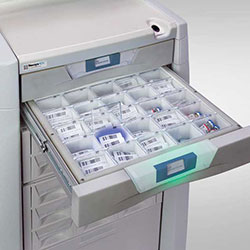
Only 2.2% of hospitals do not have ADCs on patient care units, a decline from 5.9% in 2020 (Am J Health Syst Pharm 2024 May 23. doi:10.1093/ajhp/zxae118). Most hospitals with ADCs (78.7%) use individually secured lidded pockets as the primary storage configuration; in 2008, only 51.5% of hospitals used lidded pockets. “These locked-lidded pockets are more secure than the matrix drawer configurations, in which you may have 20 to 30 medications to select from, even after you have keyed in the drug correctly to open the ADC,” said Michael Ganio, PharmD, ASHP’s senior director of pharmacy practice and quality. “Not only are they useful for preventing errors by limiting selection to the correct medication, but they are also excellent in managing controlled substances and preventing drug diversion.”
New to the survey this year is a question about the adoption of automated anesthesia workstation cabinets in operating rooms. The researchers found that 64.7% of all hospitals employ such workstations, and many of them (45.9%) have a label printer. “This is a relatively new technology, and important in an area that can be very busy,” Dr. Ganio said. “ORs have lots of safety controls, but when medications are needed quickly, sometimes in an emergency, having technology to guide the correct medication selection can significantly enhance safety.”
Overall, 73.6% of hospitals surveyed use some form of machine-readable coding to verify doses during dispensing in the pharmacy, with larger facilities using scanning during dispensing more than smaller facilities. Overall, 22.3% of hospitals use RFID tags, with 17.0% using RFID tags in medication kits or trays, 8.0% in a contracted consignment system, and 0.8% for medication location and delivery tracking.
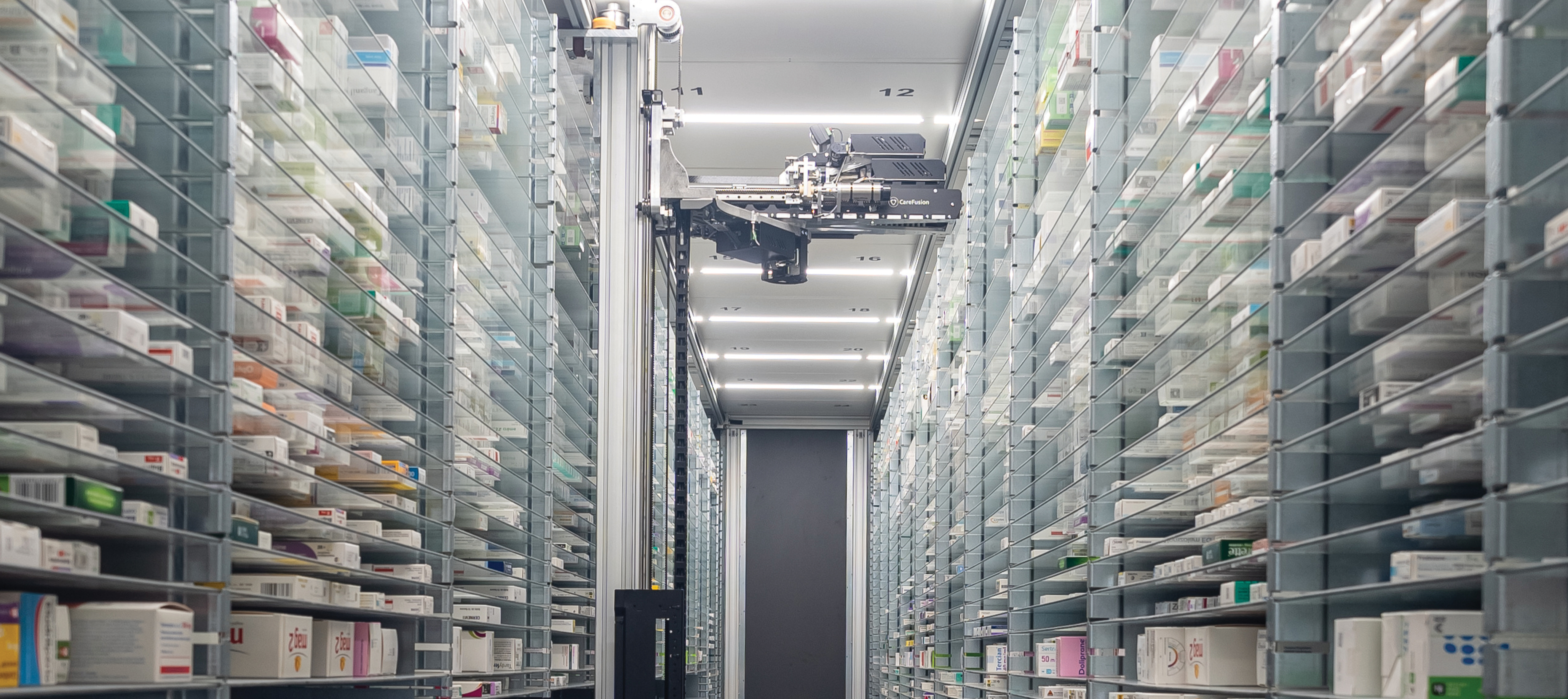
Hospitals also continue to adopt technology solutions for sterile compounding at a rapid pace, Dr. Ganio said. When ASHP first included this question in 2017, 64% of hospitals did not use any technologies for sterile product preparation. “This year, we found that only 37% of them were not doing so,” he said. “That’s pretty remarkable, since that time included the COVID-19 pandemic.”
Strides Forward at 2 Health Systems
University of Illinois Chicago
The survey findings “make a lot of sense to me,” commented Matthew Gimbar, PharmD, a clinical assistant professor of pharmacy and an associate director of operations at the University of Illinois Chicago (UIC). “The ADC numbers going from ‘great’ to ‘even greater’ is good to see; that should be a baseline for any pharmacy, and we’ve had [the technology] for as long as I can remember.”
UIC has also worked with its vendor, Omnicell, to incorporate an increasing number of lidded bins into its workstations, as well as single-dose dispensers. “Lidded bins are great both from a safety standpoint as well as for controlled substance and drug diversion management,” Dr. Gimbar said. “For many of our fast-moving controlled substances, like fentanyl and midazolam, we can load the dispensers and have them drop two into the drawer at a time. This almost [always] saves time on the countback since the nurse doesn’t have to confirm how many they’ve taken out.”
Until recently, UIC had only two anesthesia workstations in the hospital, both of which were used in the labor and delivery ORs. When it opened a new outpatient ambulatory surgery center in 2022, all eight of its ORs and eight procedure rooms were equipped with a workstation model. “We are now planning to incorporate workstations into all of the hospital’s main procedure rooms, as well as the [catheterization] lab, the GI lab, the MRI lab—anyplace where anesthesia is going to be [used]. The goal is to have that complete within the next 18 months to two years,” Dr. Gimbar said.
The workstations in the surgery center incorporate an RFID-tagged “open drawer” model from Bluesight, with standardized trays that have all individual items tagged. “This allows for more efficiency in the room,” Dr. Gimbar said. “Drawers can be swapped in and out after cases are done for the day, and turnover can be done in the pharmacy space in our own time frame.”
University of Pennsylvania Health System
At the University of Pennsylvania Health System, most of its Omnicell ADCs employ locked-lidded pockets, said Tyler Nichols, PharmD, a clinical pharmacy specialist. “Some of the cabinets are still open, but as much as possible we try to prioritize individual lock-lidded cabinets. We also utilize anesthesia workstation cabinets in all of our OR areas; those usually have more matrix-style drawers.” The health system also uses the Omnicell XR2 robotic system as its central pharmacy automation for dispensing unit-dose oral dosage forms and small-volume injectable vials.
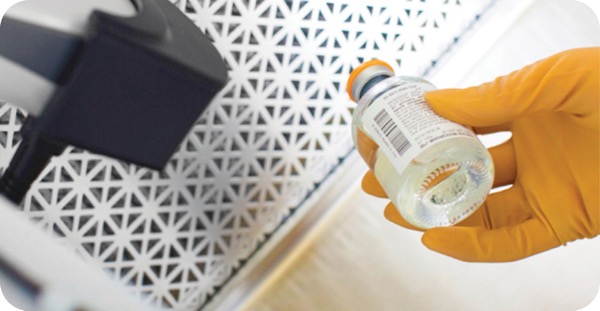
Dr. Nichols was encouraged to see the increased use of IV workflow management systems in sterile compounding areas, noting that he believes tertiary vendors do a better job in managing IV workflow than some all-in-one systems. “I worked with DoseEdge for many years at my last institution, and it offered a number of great advantages, such as greater customization of compounding processes to improve efficiency and safety,” he said. “These systems can provide step-by-step instructions for compounding, which helps with standardization of practices, [and] can prioritize the order queue by due time and identify high-priority/STAT items to help guide staff to focus on what to compound next.” The technology can also be programmed to only drop specified medications (e.g., ones with high cost or short stability) into the queue at the appropriate moment prior to due time. This avoids waste if orders are discontinued close to due times, or if medications are made too far in advance of the due time.

“Ultimately, I would suggest people review the ISMP Guidelines for Sterile Compounding and the Safe Use of Sterile Compounding Technology to review current or prospective sterile compounding technologies to determine if they meet the recommended safety standards,” Dr. Nichols said.
UIC plans to adopt an IV robotic system in its compounding area, Dr. Gimbar said, although finding space for the robot will be a challenge. “If you do a lot of batch work and standard compounding of preparations, a robot may make a lot of sense,” he said. “It can do the repetitive compounding while humans do the STAT orders and one-offs.”
More on the Horizon
Dr. Ganio sees even more extensive technology adoption on the horizon. “Given the recent implementation of [USP’s] updated General Chapter <797>, we might also anticipate even more stepped-up adoption of barcode scanning, IV workflow management software and gravimetrics in sterile compounding,” he said. “That new chapter contains requirements for master formulation and compounding records, and these technologies make it much more standardized and streamlined to capture exactly what ingredients are going into a compounded preparation.”
Although pharmacy leadership teams are likely to be pro-technology and pro-automation in general, individual needs and constraints will affect adoption, Dr. Gimbar noted. “There are factors like budget, staff and, of course, the actual physical space of your pharmacy. Incorporating 30 more anesthesia workstations into our main ORs and procedure areas means that we have to ensure that we have the power, data and physical space for them. Carousels, robots and other automation also will take up space in your department.”
The sources reported no relevant financial disclosures.

This article is from the September 2024 print issue.