





Is your pharmacy looking to expand its use of IV workflow management systems (IVWMS) on a tight budget? You’re not alone. Many health systems are currently evaluating how much IVWMS technology they can realistically afford to purchase and integrate. According to the 2023 ASHP National Survey of Pharmacy Practice in Hospital Settings, cost and budget constraints remain the leading barriers to adopting IVWMS (Am J Health Syst Pharm 2024;81[16]:684-705).
“The THRIV Coalition for IV Accuracy stands with these hospitals,” said founder Mark Neuenschwander. “We champion their adoption of IVWMS for all IV preparations and strongly encourage that systems used meet—or exceed—the technology standards outlined in our THRIV Five Checklist.” These five criteria include:) 1) workflow management software, 2) barcode scanning, 3) volume verification, 4) automated labeling, and 5) automatic documentation of each step.
Several stand-alone systems—such as BD MedKeeper, Omnicell IVX, and DoseEdge—are available that meet THRIV’s standards and can be implemented in any hospital, regardless of its electronic health record (EHR) provider. Hospitals using Epic have the added option of Epic’s Dispense Prep (EDP), which combines IV order management software with barcode scanners, cameras, labelers, and—since late 2022—gravimetric verification. When integrated, these tools within the EDP system can collectively fulfill the THRIV Five criteria, Mr. Neuenschwander said.
What’s the real-world value proposition for EDP, and what are the tradeoffs? Two health system pharmacy leaders shared their experience.
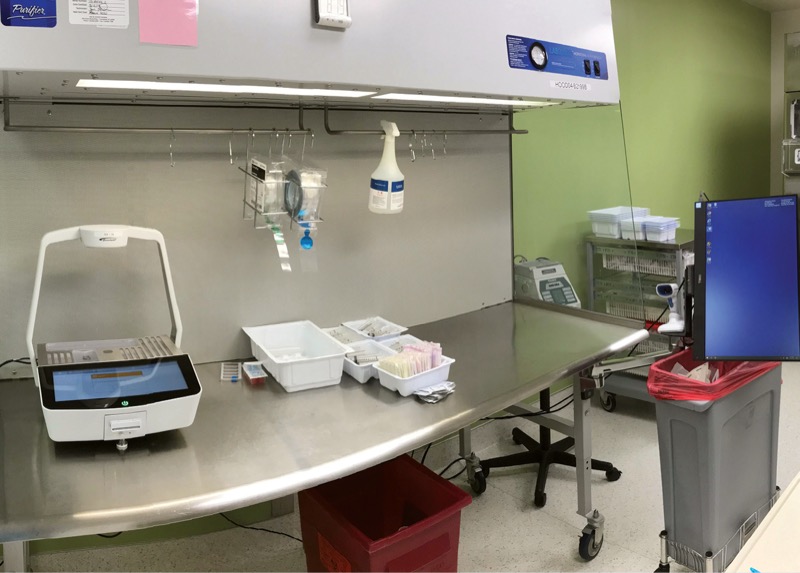
The University of Chicago Medicine had originally implemented Baxter’s DoseEdge IVWMS in the mid-2010s. “We really liked that system for a number of reasons,” said Charlene Hope, PharmD, the chief pharmacy quality and medication safety officer. “It walked the technicians through compounding step by step, we could adjust when the pharmacist verified the order, the picture resolutions were very good, and we had a lot of control of how we programmed the recipes into the system and the forcing functions.”
But this January, it was announced that DoseEdge Pharmacy Workflow Manager would be sunsetting after December 31, 2028, leaving Dr. Hope’s team (and many other health system pharmacies) on the hunt for a new IVWMS system. At the University of Chicago, since one of the inpatient pharmacy directors had experience with EDP at another institution, the decision to switch to that system was relatively easy. They began the transition in February, starting with infusion centers and using those smaller sites as pilots. The last pharmacy to go live was the system’s busiest, highest-volume location.
There are limitations, Dr. Hope acknowledged, chief among them the fact that EDP does not have the same forcing functions that DoseEdge had. “This program requires the technical staff to read through the steps on the side, rather than those steps being released to them one by one,” she said. “This is a bit of a step backward from a human factors perspective.”
Despite such issues, however, Dr. Hope said that the transition has generally gone smoothly. “We assigned our PGY-2 informatics resident to conduct a failures mode effects analysis focused one of the higher-risk workflows. He met with the team to anticipate the potential risks and plan in advance how to address them, assisted with implementation and worked through post-go live as well.”
The system has a dedicated leader assigned to oversee its compounding spaces, who has implemented a four-day dedicated sterile compounding training for compounding staff. “We do not allow technicians to fly solo in the compounding space until they have gone through that training,” Dr. Hope said.
The University of Rochester Medical Center was an early adopter of IV workflow technology around 2012, and initially found that EDP was limited in its capabilities in the IV room. “We had Epic as our EHR, but ended up seeking out third-party vendors with more robust safety systems in the sterile compounding environment. It did not incorporate the three main components of the workflow: barcode scanning, image capture and gravimetrics,” said David Webster, RPh, the senior director of pharmacy acute care operations. “It also allowed you to bypass it and still complete the product with a finished label. So instead, we partnered with what is now Omnicell and implemented their IVWMS system that is now called IVX.” More recently, he said, Epic has made significant strides with EDP, including gravimetrics options and software options that make it easier to integrate. “We do a lot of specialized compounding here, and EDP’s updates now may allow us to include things in gravimetrics that third-party vendors would not be able to support easily, so we are pretty excited about that.”
Currently, URMC runs the IVX and EDP in parallel, with EDP in one of the system’s three largest clean rooms and IVX in the two others. “The plan is for us to introduce the gravimetric piece of EDP in that clean room, and then we can get down to a true comparison of the two,” Mr. Webster said. “What are the safety enhancements? Where are the gaps? We’ll be in an evaluation phase again.”
When initially implementing IVX, the URMC team created a bidirectional interface with the Omnicell system that made it appear almost as if it were part of Epic. “It looks almost exactly the same whether you are using Epic Dispense Prep or IVX,” Mr. Webster said. “But if you are an Epic system implementing IVWMS for the first time, there is a lot of advantage to implementing EDP right out of the gate, because it’s already integrated by nature.”
Mr. Webster advised health system pharmacies to closely evaluate the safety gaps in any IVWMS system they consider. “It’s easy to focus on the pluses, but what are the gaps, the potential workarounds?” he said. The lack of forcing functions, which Dr. Hope also pointed to, has been a persistent challenge with EDP. “I think that’s what they are trying to address now, so that users can feel like they are implementing a system that will dramatically improve safety around sterile compounding to the same degree as a standalone system. Are they there yet? We’ll find out when we do our implementation and evaluation.”
While automation and systems solutions are highly effective safety strategies in sterile compounding, Dr. Hope cautioned against what she termed “substitution myth,” a tendency to assume that technology will solve all problems. “The truth of the matter is that they can also introduce other unanticipated safety issues or workflow problems,” she said. “It’s essential to ensure that you have full engagement from pre-implementation through a period of at least six months after implementation, encouraging staff to report and near miss errors, workarounds or other system failures as potential safety issues to be addressed proactively.”
The sources reported no relevant financial disclosures.

This article is from the September 2025 print issue.