






Hospital pharmacies are increasingly relying on radiofrequency identification (RFID) tagging technology to improve medication inventory management, combat drug diversion and enhance workflow efficiency. But at scale, obstacles to RFID adoption include manual tagging processes and interoperability issues. Strategies for overcoming these challenges were front and center during a recent Bluesight webinar on RFID trends in healthcare.
For BayCare Health, RFID ‘a Game-Changer’
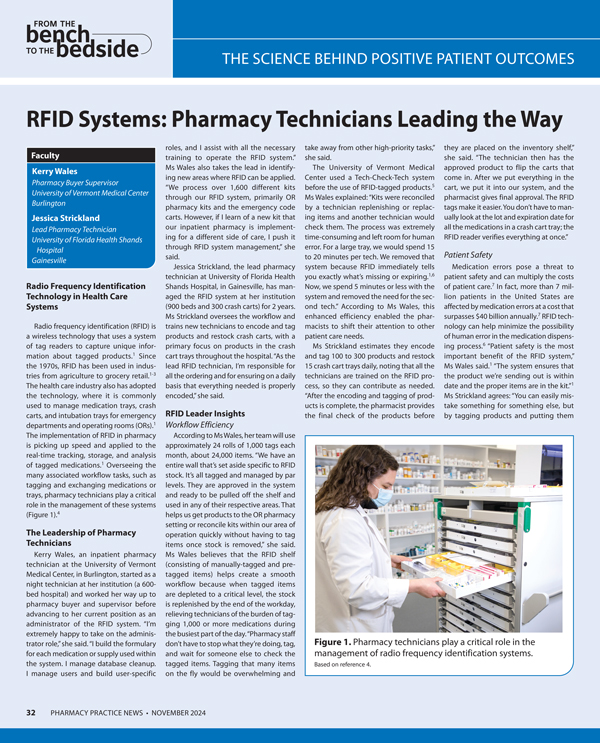
“RFID has really been a game changer for helping improve not only our pharmacy operations and the efficiency that goes along with that, but also eliminating a lot of our manual check processes,” said Les Louden, PharmD, a pharmacy manager for BayCare Health System’s St. Joseph’s Hospital, in Tampa, Fla. “We have a lot of different trays and kits that can be very prone to error, such as anesthesia trays, rapid sequence intubation kits or controlled substance kits, and having this technology has really enhanced safety for our patients.”
RFID allows the hospital to monitor drug utilization and waste, “which has been a big win for reducing inventory costs and having the right medications in those trays and kits,” he continued. “It’s also a boon for tracking expiration dates, knowing exactly what we have where, and moving medication around the hospital so that we don’t have to waste it.”
But a hospital like St. Joseph’s can tag more than 300,000 items per year, which represents a lot of manual labor for pharmacists and technicians. “That has been a limiting factor for how quickly we can get RFID into our inventory,” Dr. Louden said.
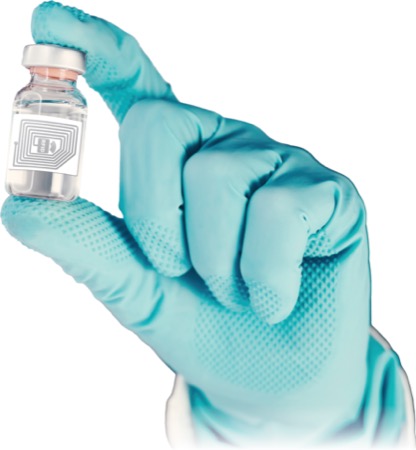
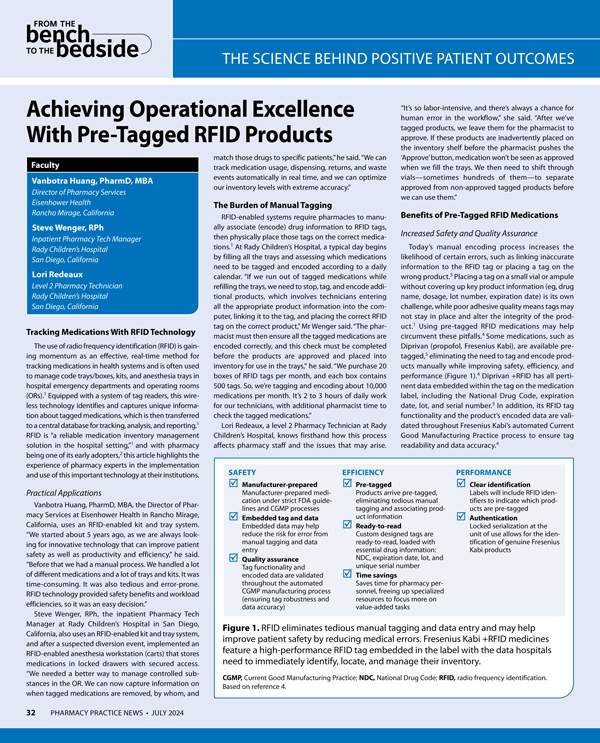
Whether the RFID tagging is performed by the health system, the pharmaceutical company, the 503B compounder or another third party, it must be done—and until it can become more seamless, it will be difficult for RFID to grow in the pharmaceutical space, the experts agreed.
But in the meantime, it’s important to focus on tagging the right products, said Andrew Brereton, the vice president of corporate sales at Tecsys, a supply chain and inventory management solutions provider. “Instead of saying ‘We’ve got to tag everything,’ which is going to create a lot of unnecessary work, start by identifying your products that really need to be RFID tagged,” he advised. “I’m going to manage a box of bandages very differently than I’m going to manage a hip or an implant [device] or a high-dollar drug.”
Space constraints are also a concern for RFID tagging. Mr. Brereton noted the recent growth of off-site consolidated pharmacy service centers (CPSCs) at many health systems. “That’s a perfect location for RFID tagging to be done,” he said. “Tagging can also be done in a very specialized way, working with state authorities so that you don’t have to use a pharmacist to do it, while ensuring that the process you build is rock-solid so that it is done in an extremely accurate way. If you’re planning a CPSC, that’s something that you want to consider.”
What the Future May Hold
RFID is already transforming inventory management, overcoming limitations of barcodes such as duplicate scanning and the need to scan individual items one at a time. But what’s next for the technology?
“We’re already really good at RFID with kits and trays,” Dr. Louden said. “Can we start integrating RFID into the electronic health record, and using it in areas such as automated dispensing cabinets and refrigerators and freezers where we store our highest-cost medications? There’s definitely a lot of opportunity.”
Dr. Louden also suggested that making the RFID tags more seamless would improve the process. “Sometimes anesthesia providers complain about the tags getting stuck together in trays or bins,” he said. “If the tags can become more integrated into the vials, and they don’t have to do any scanning because the RFID is automatically registered when the product is removed from the tray or ADC, that would be very helpful.”
Peter Bloch, the North American market development manager at leading RFID provider Avery Dennison, predicted that more and more products—not just medications—will come into the supply chain already tagged. “I think we’re going to start to see things like attachments, needles, syringes and tubes tagged, and the tag could even inform the equipment on which assay or experiment to run, what diagnostic to do, and how to set up the equipment to make it more reliable,” he said. “There’s all kinds of new innovation that will allow RFID to tell more and sense more factors about the item that it’s tagged to, such as temperature, vibration and humidity.”
Mr. Bloch also speculated that the current “RFID chip” will ultimately be replaced by printed circuits that will be much more sustainable and less costly. “The information transfer likely will happen with Bluetooth and LTE networks, making almost real-time visibility of items possible, instead of just when you’re trying to scan something and find it,” he said.
Mr. Block also suggested that RFID technology will enable authentication and block counterfeiting in the drug supply chain, to the advantage of institutions as well as individual patients. “As a patient, I could use a ubiquitous device like my cellphone to tap on the drug and understand if it’s real or not, and whether it’s for me,” he said. “Then I could potentially use that application on my phone to exchange drug utilization information with my provider, my family member or drug manufacturer to improve medication management and patient outcomes in the long term.”
The sources reported no relevant financial disclosures.
This article is from the February 2025 print issue.