





The FDA has approved more than 40 cellular and gene therapy (CGT) products to date. However, there is a lack of regulation to mitigate the risks these new treatments pose to healthcare workers, according to a paper in the American Journal of Health-System Pharmacy. The authors proposed standard operating procedures (SOPs) for handling emerging therapies to protect pharmacists who come into contact with these new compounds as they grow in number and availability (2025 Feb 6. doi:10.1093/ajhp/zxaf026).
“Unlike more traditional drug treatments, gene therapy agents themselves can have associated infectious risks,” explained study author Stacey Yu, PhD, a scientific research and communications writer at Stanford Health Care (SHC), in Palo Alto, Calif. “Because of the gaps in current occupational safety guidelines that focus more on laboratory environments rather than pharmacy settings, creating and implementing these SOPs increases our staff safety.”
Implementing SOPs “is particularly needed due to the increasing prevalence of gene therapy products approved by the FDA and the potential occupational safety concerns for healthcare professionals,” Dr. Yu told Pharmacy Practice News.
The SOPs were created by an interdisciplinary team that included infectious disease specialists, oncologists and pharmacists at SHC. The SOPs are designed to protect a wide array of hospital staff who could potentially encounter or handle gene therapies at any point in operations. The researchers considered pathways of ingestion, injection, dermal absorption, mucosal absorption and inhalation. Due to the lack of available data on the risks of handling these agents, Dr. Yu said, they opted for “a cautious approach for handling restrictions,” especially to protect staff who are immunocompromised.

The SHC team analyzed how gaps in personnel awareness, workflow procedures and supply of necessary decontamination products posed potential risks. To address these vulnerabilities, the health system has implemented several key SOPs (Table).
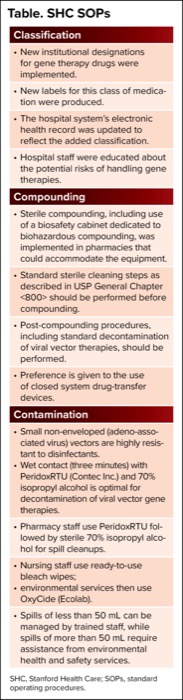
| Table. SHC SOPs |
| Classification |
|---|
| New institutional designations for gene therapy drugs were implemented. |
| New labels for this class of medication were produced. |
| The hospital system’s electronic health record was updated to reflect the added classification. |
| Hospital staff were educated about the potential risks of handling gene therapies. |
| Compounding |
| Sterile compounding, including use of a biosafety cabinet dedicated to biohazardous compounding, was implemented in pharmacies that could accommodate the equipment. |
| Standard sterile cleaning steps as described in USP General Chapter <800> should be performed before compounding. |
| Post-compounding procedures, including standard decontamination of viral vector therapies, should be performed. |
| Preference is given to the use of closed system drug-transfer devices. |
| Contamination |
| Small non-enveloped (adeno-associated virus) vectors are highly resistant to disinfectants. Wet contact (three minutes) with PeridoxRTU (Contec Inc.) and 70% isopropyl alcohol is optimal for decontamination of viral vector gene therapies. |
| Pharmacy staff use PeridoxRTU followed by sterile 70% isopropyl alcohol for spill cleanups. |
| Nursing staff use ready-to-use bleach wipes; environmental services then use OxyCide (Ecolab). |
| Spills of less than 50 mL can be managed by trained staff, while spills of more than 50 mL require assistance from environmental health and safety services. |
| SHC, Stanford Health Care; SOPs, standard operating procedures. |
A Good Starting Point
“The Stanford team provides practical guidance that could be used as a starting point for other health systems who need to develop biosafety policies for their pharmacies,” commented Michael Storey, PharmD, a medication use strategist at Nationwide Children’s Hospital, in Columbus, Ohio.
He warned that the next frontier for CGTs will be community health systems, which often lack the facilities and expertise to handle these agents. However, he proposed that “pharmacy has an opportunity to lead in these centers, because pharmacies can receive final cell therapy products after manufacturer processing and [safely] dispense it for use at the time a therapy is due.” (For more of Dr. Storey’s tips for gene therapy safe handling, see bit.ly/41MAh4j-PPN.)

Dr. Yu acknowledged that her team’s guidelines are limited by the newness of gene therapies and rapid growth and change surrounding these treatments. She suggested that as CGT technology continues to evolve, SOPs will require ongoing updates reflecting new data on adverse events.
She concluded that “it is essential to continuously evaluate and refine the established SOPs based on real-world experiences, emerging findings regarding the safety of these therapies and feedback from healthcare staff who handle the therapies.”
The sources reported no relevant financial disclosures.



This article is from the May 2025 print issue.