
Originally published by our sister publication Specialty Pharmacy Continuum

With final Drug Supply Chain Security Act (DSCSA) exemption dates ending this year for most stakeholders—May 27 for manufacturers, Aug. 27 for wholesale distributors and Nov. 27 for dispensers with more than 25 full-time equivalents licensed as pharmacists or who qualify as pharmacy technicians—the pharmaceutical supply chain is approaching full regulatory implementation. Following several extensions, including a stabilization period, these deadlines are expected to hold.
The industry has made significant strides in implementing DSCSA requirements and adopting serialization and data exchange systems, which have enhanced traceability and product verification. However, managing discrepancies between physical shipments and serialized data, referred to as exception handling, remains a key area of risk that could undermine these advancements.
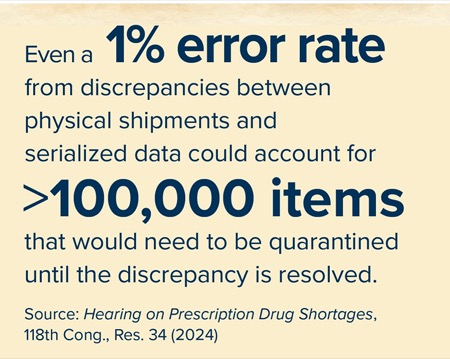
Even at a success rate of 99%, the remaining 1% error rate could account for more than 100,000 items that would need to be quarantined until the discrepancy is resolved, according to congressional testimony by a representative from McKesson.
When serialized product data do not align with the physical shipment—due to misaligned master data, quantity mismatches, unreadable barcodes or incorrect serial numbers—products must be flagged as noncompliant and quarantined. These unresolved exceptions could delay inventory, trigger compliance risks and exacerbate drug shortages. For pharmacies, such exceptions could stall access to critical medications, potentially delaying patient care.
What Do Exceptions Look Like?
Consider this scenario: A hospital pharmacy receives a shipment of specialty medications. The shipment consists of 50 units, but the serialized data transmitted provide the event data for only 48. All units scan correctly, and the barcodes are intact, but the mismatch between the physical count and serialized data triggers an exception. Under DSCSA, the pharmacy cannot dispense the two additional units and may not accept the entire delivery into inventory until the discrepancy has been resolved. The units would need to be reconciled at the serialized item level to identify the two missing units that have no corresponding data.
Without a clear process, the pharmacy must coordinate with the distributor and manufacturer to trace the mismatch: Is it a packing error, a data entry issue or something else? In the meantime, patient access to critical therapies could be delayed, especially in cases where these medications are needed for scheduled treatments.
Common exception scenarios include quantity mismatches (when the serialized units received don’t match transaction records), packaging errors, mislabeling, inaccurate serialization and scanning issues that prevent verification.
Each scenario requires multiparty coordination, root cause analysis and timely resolution—underscoring the need for streamlined workflows and shared accountability. As the scenario illustrates, while DSCSA has driven widespread adoption of unit-level traceability and serialized data exchange, exception handling remains critical. Its effective implementation will be tested as enforcement deadlines trigger shipment rejections or product being quarantined for unresolved discrepancies. Resolving exceptions requires thorough documentation, standardized processes and collaboration across trading partners. Disconnected workflows can leave discrepancies unresolved for days or weeks, slowing medication delivery and increasing compliance risks.
The Link to Traceability
Exception handling is intrinsically tied to traceability. Under DSCSA, 2D data matrix barcodes are required for product identification and unit-level traceability. Although the regulation doesn’t mandate any specific data format, the GS1 DataMatrix has been adopted widely across the industry for consistency and interoperability. GS1 Standards provide a common language for product and location identification through Global Trade Item Numbers (GTINs) and Global Location Numbers (GLNs). They enable data exchange via GS1 Electronic Product Code Information Services (EPCIS), which allows trading partners to share detailed information about product life cycle events—where and when products were produced, packed, shipped or received—helping to pinpoint the source of discrepancies.
Although standards such as EPCIS enable data visibility, they don’t prescribe how exceptions should be resolved. That requires structured business processes and coordinated partner engagement.
Recognizing the need for consistent exception handling, GS1 US recently released an Exceptions Handling Addendum to its DSCSA Implementation Suite. This resource provides comprehensive guidance for resolving exceptions meeting DSCSA requirements, including serialization, EPCIS data exchange, product verification and traceability. The addendum expands on this by offering:
- workflows for identifying, investigating and resolving exceptions;
- recommendations for leveraging EPCIS event data to track discrepancies; and
- protocols to ensure efficient resolution across manufacturers, distributors and dispensers.
These best practices are designed to help trading partners systematically address exceptions, closing the remaining gaps in DSCSA readiness.
More Resilience Needed
More than a regulatory obligation, robust exception handling is a cornerstone of operational resilience and patient safety. When exceptions are resolved systematically and collaboratively, healthcare supply chains gain:
- improved visibility, allowing real-time detection and resolution of issues;
- enhanced patient protection, ensuring only verified products reach care settings; and
- greater agility, enabling swift responses to recalls, shortages or other disruptions.
As DSCSA enforcement nears, exception handling becomes a priority. By standardizing workflows, aligning with trading partners and following guidance, healthcare supply chains can safeguard compliance, ensure uninterrupted medication access and protect the patients they serve.
For more information about GS1 Standards and DSCSA resources, visit GS1 US Healthcare.
Ms. Nasarenko is the vice president of customer success at GS1 US, a not-for-profit global data standards organization that helps companies and trading partners identify, capture and share digital supply chain data.