
Clinicians sometimes order CT and MRI or lab tests to avoid potential litigation rather than for their diagnostic value. Although that self-protective strategy may reduce personal liability, it comes at the cost of a negative effect on the environment, a sustainability expert noted during the 2025 Critical Care Congress, in Orlando, Fla.
“We should only perform tests that we absolutely need to do,” said Seema Gandhi, MD, an anesthesiologist and the medical director of sustainability at the University of California, San Francisco.
Dr. Gandhi has led efforts to increase environmental sustainability at UCSF Health. During her presentation and in a subsequent interview with Pharmacy Practice News, she focused on strategies healthcare practices can take to reduce the environmental footprint of their operations.
“MRI machines are left on for 24 hours, which is an enormous energy cost,” Dr. Gandhi said. And every blood draw for a lab test requires disposable test tubes made from plastic that are derived from petroleum. This is an environmental burden for our health practices, she noted, especially because many of these diagnostic test results will not change care significantly.
Dr. Gandhi applauded efforts to minimize the environmental impact of MRI and CT machines. Some MRI devices, for example, include an “eco” mode that automatically turns off the machine’s power-hungry amplifier when the system is inactive for any extended time (bit.ly/4j4O64j). That said, using a greener machine does not change the fact that many of these scans are unnecessary. “You would not start washing more loads of laundry just because you bought a green washing machine,” Dr. Gandhi said.
Unnecessary diagnostic tests are what health policy experts term “low-value care,” she noted (Int J Health Policy Manag 2021;11[8]:1514-1521). Upwards of $78.2 billion of waste in the United States can be attributed to overtreatment or low-value care (JAMA 2019;322[15]:1501-1509). When Dr. Gandhi practiced in the United Kingdom, she recalled, diagnostic tests had to be justified before they were approved. In the United States, in contrast, such decisions shifted to colleagues asking her to explain why a test was not needed.
Dr. Gandhi said these wasted costs would be better spent reimbursing primary care or family medicine practices, or on projects such as strengthening lifestyle support for people with diabetes.
More Responsible Use of Volatile Anesthetics
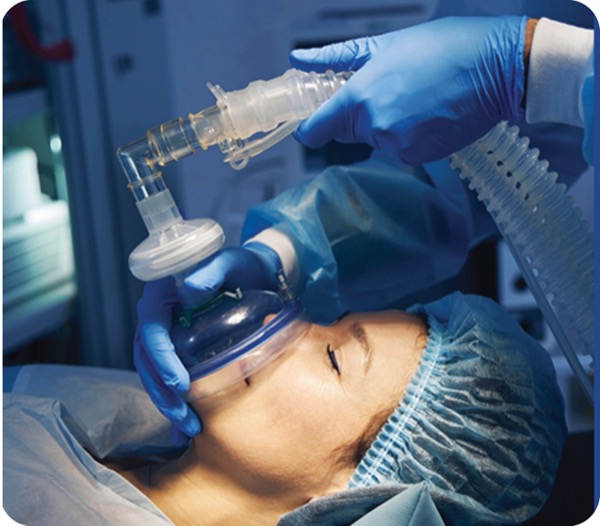
Still, a medical intervention sometimes is necessary. For example, general surgery and intensive care support are not possible without providing anesthesia. But the choice of what gas to use can make a big difference.
At UCSF Health, Dr. Gandhi led an effort to eliminate the use of desflurane, an anesthetic gas with the highest global warming potential, with an effect estimated to be 2,540 times more than that of carbon dioxide (Anaesthesia 2022;77[9]:1023-1029). This is an especially notable change at UCSF, considering it was the place of invention for desflurane. The anesthetic, which along with its main counterparts is considered to be a greenhouse gas, had become a mainstay at UCSF and elsewhere, before its negative environmental effects were deeply understood.
“Here I was at the place that invented desflurane, saying we no longer needed it,” Dr. Gandhi recalled. Despite that history, the effort was a huge success: UCSF Health has eliminated desflurane since 2022.
UCSF also has adopted a low-flow practice for sevoflurane, which typically involves using a fresh gas flow of 1 L per minute or less, versus the 2 to 3 L per minute often used during anesthesia. Data suggest that employing a low flow rate policy for sevoflurane during general anesthesia can reduce consumption by nearly 40% (Korean J Anesthesiol 2011;60[2]:75-77). (Studies linking low-flow sevoflurane to a theoretical risk for renal injury have not been confirmed in real-world clinical practice, despite an FDA recommendation to step up to a higher flow rate after low-flow induction, the authors of the 2022 Anaesthesia review noted.)
Other efforts to reduce the environmental impact of anesthesia typically focus on moving away from administering nitrous oxide through facility piping. Between 70% and 90% of nitrous oxide is lost through such piping, according to a 2023 report (Jt Comm J Qual Patient Saf 2023;49[6-7]:336-339).
Reducing Waste in Pharmacies
“I have been a lifelong environmentalist, and I’ve always been concerned about the amount of waste we create in pharmacy,” said Jeannette Wick, MBA, RPh, FASCP, the director of the Office of Pharmacy Professional Development at the University of Connecticut, in Storrs. “Everything comes packaged in a bottle, pushed in with cotton and sealed with a piece of foil in its own individual box,” she noted, citing these packaging practices as particularly wasteful and damaging to the environment.
“That’s one concern, but the other is drugs in the environment,” Ms. Wick said. People might throw unused pills into the trash or wash topical medications down the drain; and consumed medications and metabolites are excreted in urine or feces whenever a drug is not fully metabolized. All of these actions can contaminate drinking water supplies, causing harm to fish and possibly humans, as noted in a report from the Environmental Protection Agency on unsafe disposal of hazardous waste pharmaceuticals (bit.ly/4coKFmq).
Pharmacy leaders should do their part to properly dispose of the drugs under their care, Ms. Wick advised. She suggested a mix of strategies that might include just-in-time purchasing to reduce waste, sending unused controlled substances to a reverse distributor for proper disposal and extending expiration dates of shelf-stable medications beyond those recommended by the manufacturer. However, she acknowledged that enacting such strategies might be an uphill climb.
“I’m still amazed that most pharmacies don’t recycle. They don’t separate their papers from their plastics, from their aluminum, from whatever,” Ms. Wick said.
On the other hand, pharmacists are doing a better job of advising prescribers to use the lowest possible dose for the shortest possible time than they used to, Ms. Wick said. Besides lowering drug burden and possible toxicities for the patient, this reduces the risk that people will abandon a too-high dose and then throw unused medications in the trash.
The pharmacy students she teaches generally agree about the importance of environmental stewardship, Ms. Wick said. But the daily grind of work, after students graduate and start practicing, usually precludes environmental activism.
“Pharmacies are extremely short-staffed and busy. People go home at the end of the day and they’re tired. They don’t want to be civic activists,” Ms. Wick said. But pharmacy leadership that prioritizes environmental concerns can move this needle, she noted.
The sources reported no relevant financial disclosures.