

Automated dispensing cabinets (ADCs) should have dynamic search configurations that only return one medication rather than a handful of medications that a clinician must choose from, the Institute for Safe Medication Practices (ISMP) recommended in a recent Call to Action article on the issue (bit.ly/3VrrwZE).
During clinical emergencies, busy practitioners may inadvertently select the wrong medication, ISMP leaders noted. To prevent these mishaps, some ADC software requires entering a minimum of five characters during a drug name search, for medications that are not already in a patient’s profile but which they need immediately. Although ISMP supports the five-character minimum, its president says this measure is not sufficient to prevent errors, such as pulling hydroxychloroquine instead of hydroxyzine.
“Healthcare is light-years behind how we use technology in our everyday lives,” said ISMP President Rita Jew, PharmD, MBA. On e-commerce sites, she noted, you can reach only one item after entering enough keystrokes, thanks to algorithms that streamline item choice. Healthcare technology should have the same sophistication, Dr. Jew said. “If you don’t have a dynamic search, people are going to pick the wrong drug,” she stressed, not just in an ADC but also in electronic health record (EHR) systems.
Besides adding dynamic search, another useful ADC and EHR software improvement, per the ISMP, would be to use standard medication names such as “Tylenol with Codeine #3,” not “Tylenol #3.” Dr. Jew encouraged pharmacists to request such changes, noting that vendors are unlikely to invest software development time until they know there’s a demand for this work.
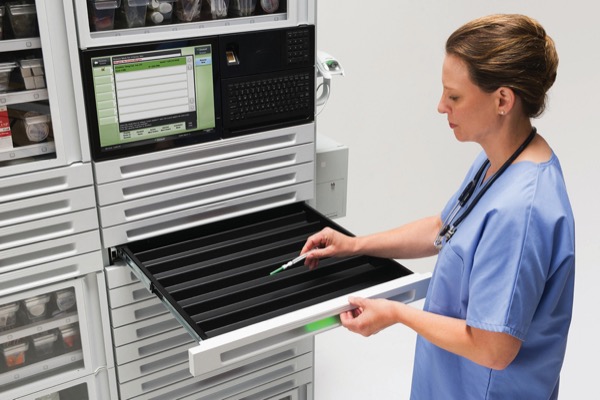
But it’s not just a software design question; organizational policies also can promote patient safety. For example, hospital leaders could require that nurses, pharmacists or physicians enter an indication when requesting a drug override. This is a research-backed method for distinguishing among similar-sounding drug names, even without an algorithm that drills down to only one drug (J Am Med Inform Assoc 2018;25[1]:872-884).
If fewer drugs are available in a patient’s override list, because their approved medication profile is more comprehensive, this would also reduce the risk for error. To that end, “tighten up your override list,” Dr. Jew said. “If you don’t need to override the medication, you wouldn’t have the problem of needing to look for it.” Additionally, always make sure that high-alert drugs are only available in patient care areas where their use is appropriate. “A neuromuscular blocking agent should never be available in the [medical-surgical] unit; it should only be available in the intensive care unit,” she stressed.
If the override list is trimmed and drugs are only available for overrides in appropriate patient care units, the number of errors associated with overrides should decline. For whichever scenarios are left, dynamic search should be available, Dr. Jew noted.
Seeking Standardization
“We are looking at ways to standardize our EHR drug names to all of our downstream systems,” such as ADCs, said Ryan Cello, PharmD, the pharmacy manager at UC Davis Health, in Sacramento, Calif. This is among the ISMP’s suggestions for reducing medical error when using ADCs.
Dr. Cello noted that complete drug name standardization can be complex to implement because it requires that the EHR, inventory management system, ADC and all other clinical software use the same vocabulary. This takes effort to align and then maintain, with UC Davis considering purchasing additional software to help automate the ongoing system standardization.
The aforementioned five-character minimum needed when searching for drugs in an ADC “is something that we recognize as being important, but we have not turned it on yet,” said Dr. Cello, an author of ASHP’s guidelines on the safe use of ADCs (Am J Health Syst Pharm 2022;79[1]:e71-e82; bit.ly/3OpjnKR).
Caution is needed because the ADC software that UC Davis uses is “all or nothing,” Dr. Cello noted. Once turned on, five characters are needed for any drugs not in a patient’s profile, even if they’re at a clinic for a routine appointment and not in an emergency that needs an override. In these cases, clinicians could see the five-character rule as a hindrance more than a help, Dr. Cello noted. There was similar resistance when UC Davis moved to a three-character minimum search requirement, he recalled, because people had become proficient at searching without needing to input in this way.
This experience does not mean five characters will never happen, Dr. Cello said. “We are currently talking to everyone and educating them” about the five-character minimum, he said. ISMP recommends rolling out this change carefully, he added, including an analysis of how it would impact workflow in different areas.
As an example, Dr. Cello noted that UC Davis staff will need to relabel some items in the formulary, including devices used to deliver drugs, so they are still findable with a five-character minimum. In the interim, “we continue to require targeted alerts on overrides of neuromuscular blockers and storage in lidded bins with stickers on top to each bin indicating a high-risk medication. We also have an ongoing review of our override list and overrides to ensure what is available to users on override is appropriate and safe.”
The sources reported no relevant financial disclosures.